Muthea: A Handmade Brushed Font for Authentic Branding
I had just opened a blank brand board for a small-batch coffee roaster that wanted their packaging to feel like it had a story. They didn’t need polished and perfect—they wanted texture, warmth, and a touch of the unpredictable. Clean sans serifs felt sterile, polished scripts felt too formal, and regular hand-lettered fonts were missing that raw edge. That’s when I loaded up Muthea, a brushed texture font that immediately changed the room.
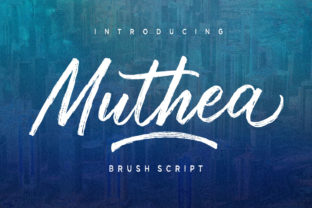
Muthea is a display font with a deliberately irregular baseline and a hand-painted texture that feels genuinely crafted rather than simulated. It belongs to the script font side of the designer’s toolkit, but it carries the personality of a handmade font that’s been dragged across rough paper. This isn’t the kind of typeface you hide in small captions; it’s the one you put on the front of a bag of coffee beans or the hero section of a creative studio’s website.
The Visual Personality of Muthea
What strikes you first is the texture. Each letterform appears to have been brushed with a slightly dry bristle, leaving organic gaps, thin spots, and edges that refuse to sit still. The irregular baseline reinforces that handcrafted impression—characters dance slightly above and below the invisible line, creating a rhythm that feels more like sign painting than digital type. There’s a grounded, earthy quality to it that makes it perfect for brand identity projects that need to communicate honesty and a human touch.
Mood-wise, Muthea leans into warmth and approachability. It’s casual without being sloppy, expressive without shouting, and rugged without feeling messy. For designers working on logo design for artisan bakeries, handmade skincare labels, or workshop signage, this font brings a tactile quality that’s hard to fake. It doesn’t fit the sleek tech startup or the luxury fashion house, but for a premium font that celebrates imperfection, it hits the sweet spot.
Stress-Testing Muthea in a Real Branding Project
To really understand what this typeface can do, I decided to push it into a full brand refresh concept for that coffee roaster. I didn’t just mock up a logo—I ran Muthea through an entire brand identity system, from business cards to social media layouts, packaging mockups, and a website header.
On the primary logo draft, Muthea carried the roastery name with a confident, handmade presence. The irregular baseline and brushed strokes looked like someone had actually painted the brand name on a reclaimed wood sign. At large sizes, the texture becomes a design feature in itself. I placed it on a kraft paper packaging mockup and the result felt cohesive immediately—no extra distress filters needed. The font’s natural grain aligned perfectly with the organic product, making the packaging design feel intentional rather than overworked.
For the business card, I scaled Muthea down for the name while pairing it with a clean sans serif for contact details. The contrast worked beautifully. The texture still registered clearly on a matte printed sample; it didn’t fill in or turn muddy, something I’d been quietly worried about. On a website header mockup, the font held its own as a statement piece over a full-bleed photo of a coffee pour, instantly setting a crafty, independent tone. And on Instagram story templates, a short phrase set in Muthea felt like a human voice among a sea of overly polished social media graphics.
That said, not every application was seamless. When I tested Muthea in a longer tagline at small point sizes on a product label, the irregular baseline started to affect readability. The strokes became spindly, and some letter combinations felt visually jarring. This confirmed what I already suspected: Muthea is not a text face. It’s a headline font, a logo font, and an accent font meant for short, impactful phrases.
Projects Where Muthea Delivers Its Best Work
After testing, I can confidently say that Muthea excels whenever you need a single word or a few words to carry the visual weight of a design. It’s ideal for:
- Clothing and apparel with a hand-printed or vintage feel
- Greeting cards and stationery that celebrate the handmade aesthetic
- Product labels for organic food, craft beverages, and skincare
- Editorial pull quotes and magazine spreads craving a tactile contrast
- Website hero sections and landing page headers for creative studios
- Posters, flyers, and event announcements where texture communicates atmosphere
In each of these contexts, Muthea operates as a decorative font that doubles as a storytelling device. It’s not just delivering words—it’s reinforcing a brand’s dedication to craftsmanship. I’ve seen similar handmade script fonts fall apart when you look too closely, because the texture feels synthetic or the irregular baseline looks accidentally broken. Muthea avoids that trap. The variation feels studied and consistent, which is what makes it a creative font worth returning to.
When to Hold Back
No font works everywhere, and Muthea has clear boundaries. The brushed texture and irregular baseline, while beautiful at display sizes, create friction in smaller applications. If you’re designing a long booklet, a dense menu, or body copy for a website, this isn’t your choice. Readability suffers quickly below 14 points on screen, and in print, the thin strokes may break on uncoated papers when overused at tiny sizes.
It also carries an inherently casual personality that might clash with formal corporate identity, legal documents, or minimalist luxury branding that relies on restraint. If the project demands a clean, geometric, or highly polished look, a more controlled sans serif font or classical serif will serve better. I also found that Muthea’s handcrafted vibe can overpower a layout if overused; I’d treat it as a hero element rather than repeating it across every touchpoint of a brand identity.
Before committing, I always recommend printing a few test words at the intended final size on the actual stock you plan to use. The irregular baseline and brush texture interact differently with coated, uncoated, and textured papers. A quick physical proof answers questions that screen previews cannot.
Pairing Muthea for Balanced Typography
Part of making this font shine is giving it room to breathe beside a quieter partner. Because Muthea is so expressive, I almost always pair it with a straightforward sans serif font for secondary information. Clean geometric sans or humanist sans styles work especially well—they anchor the design without competing. Think of typefaces with neutral x-heights and open counters; they let Muthea’s texture stand front and center while maintaining overall readability.
For more editorial or slightly refined projects, a light serif can create an interesting tension. A delicate, airy serif font counterbalances the rugged brushwork, lifting the pairing into something more curated. I’ve tested this on a local café visual refresh concept where the logo used Muthea and the menu descriptions sat in a classic old-style serif. The combination felt intentional, not chaotic.
Avoid pairing Muthea with another heavily textured script or a competing handwritten font—the result tends to look like a visual argument. Instead, let one voice lead. Muthea works best when it’s given the primary role in the modern typography system, with supporting type acting more like quiet furniture.
What’s Included and a Word on Licensing
As a display font built for impact, Muthea typically comes in a single weight, which is common for this kind of hand-brushed script. The character set usually supports multiple languages, making it usable for international branding projects without missing accents or special characters. File formats generally include standard desktop options like OTF and TTF; webfont versions may be available separately if you plan to use it in live web design.
I didn’t discover an extensive set of stylistic alternates or swashes in my test—the font relies on its inherent texture and baseline irregularity to create variety. That simplicity can be an advantage. You’re not spending hours hunting for the right alternate; you just type and let the font’s natural rhythm do the work. However, always check the product page for any OpenType features that might be bundled with the version you purchase.
One practical reminder from years of commercial font use: check the license terms before using Muthea in client work, merchandise, print-on-demand products, or digital templates. Standard desktop licenses often don’t cover logo trademarks, product creation, or unlimited web impressions. If you intend to build a brand identity around it or use it on packaging that will be sold commercially, you may need an extended or custom license. Confirming this early saves headaches down the road and keeps your design assets legally solid.
Muthea isn’t going to replace your workhorse typefaces for long-form reading, but it’s the kind of font you keep in your back pocket for moments when a brand needs a voice that feels unmistakably human. After watching it transform a simple coffee label into something that looked like it had been painted with care, I’m already looking for the next project that needs that raw, artisanal energy.